If you read my Rattlesnake Granny Books, you know that I love folklore, especially that of the old and odd kind. Here is some new to me folklore (that is not in the Rattlesnake Granny books.)
Bartmann Jugs
In December 2025, as is my custom, I went to the open studio show and sale of regional artist and master potter Michael Hough. He creates contemporary pieces, though the ones that appeal most to me are his representations of older pottery forms. This guy caught my eye due to the “wild man” face. It was my purchase of the day.
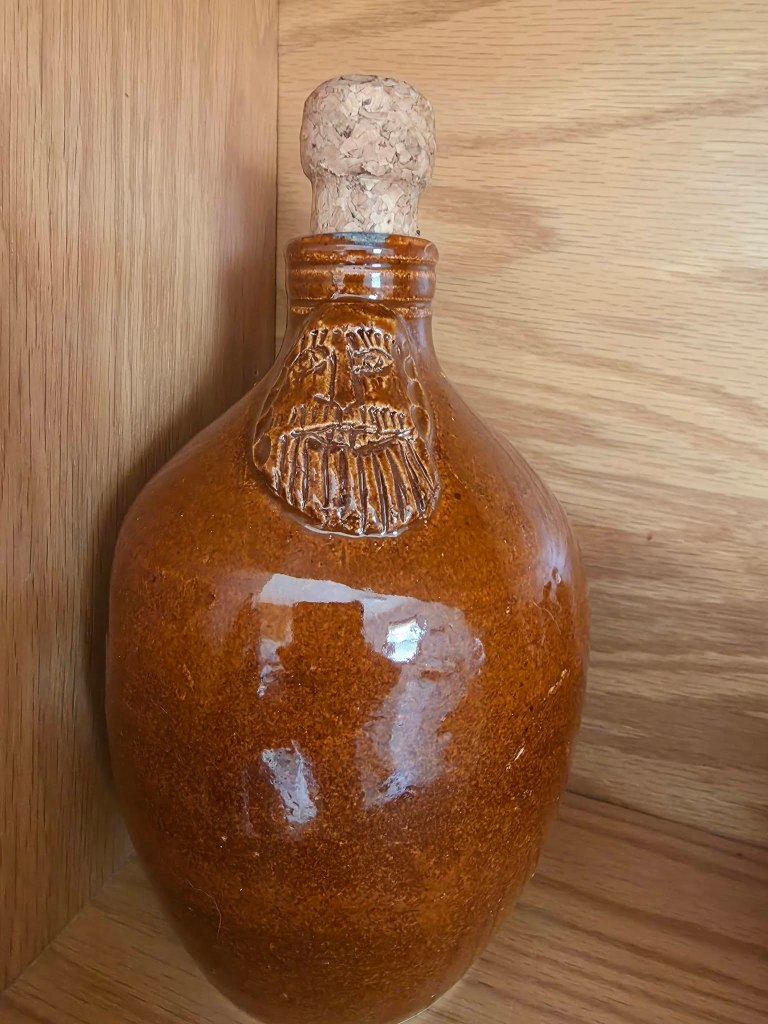
What is it?
It is a Bartmann style jug made by modern potter Michael Hough
Upon getting home, I looked up the history of this form.
It is a Bartmann (bearded man) or Bellarmine Jug! These types of jugs are very old, having become common in Western Germany in the 1500 and 1600s and with a later revival. This one is a fairly simple example. Some historic Bartmanns have ornate ornamentation on the body of the jug. These jugs spread across Northern Europe and were brought to early America. In old England, they called them graybeards.
And get this, they were used as “witch bottles.” I am not using mine for witchcraft, however, so if your back hurts, it is not me. IT IS NOT ME.
Apparently to use them for witchcraft, one would need to select one with a particularly sinister little face, fill it with all kinds of nastiness, and tuck it away. Historic Bartmann jugs used as charms have been found with nails, cloth, hair, and (okay this is nasty, pee) inside.
I supposed that I had seen these Bartmann jugs before then but hadn’t registered them as a folk-art form. I first thought it was a “toby jug” when spotting it at the pottery sale. Toby Jugs are more English and figural however, so that shows what I know.
The Quandrantid
The newspaper today had a story about the current Quadrantid meteor shower. It says that the name of the meteor shower is based on a “constellation that is no longer recognized.” And it has this picture from the Library of Congress (public domain.)
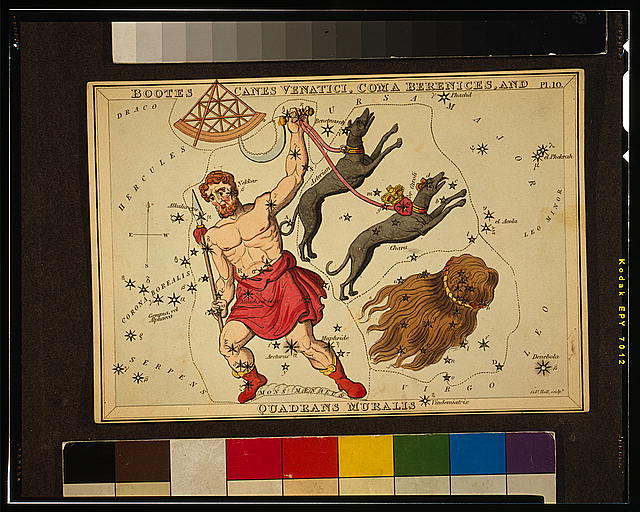
The image shows Bootes the Ploughman, the dogs Asterion and Chara, a quadrant, and the hair of Bernice. Yes, that is hair in the sky.
I thought at first that it must be Bootes the Ploughman, a Northern Hemisphere constellation, that was no longer recognized. But no, the Herdsman is still a thing. Instead, it is that quadrant (an astronomical measuring tool) shown hanging above him that is no longer recognized as a constellation. According to Wikipedia, a French astronomer created the constellation Quadrans Muralisin in 1795. So, it was not an ancient observation. It appeared in some astronomical atlases until yeeted by the International Astronomical Union in 1922. But its name lives on in our Quadrantid meteor shower. How cool is that?
How about that hair of Berenice though? It is still a well-recognized constellation! What’s more, Berenice was a real person (not a myth, though she was later believed to be divine). She was Berenice II Euergetis, an ancient Egyptian queen. Coma Berenices or Berenices’ Lock constellation is based on a story that she cut off her hair and gave it as an offering in prayer that her husband would come back from war. Another version says that she offered to cut off her beautiful long hair for this favor and did so after husband came back safe from battle. He was Ptolemy III Euergetes. When her hair was not found where she left it, an astronomer speculated that the goddess Aphrodite had thrown it into the heavens to show as a constellation and honor the queen’s sacrifice. Though Queen Berenice was later worshiped as a goddess, how interesting that she was a real person, and the hair sacrifice story is also probably real.
Of course, these are not the only interpretations of these constellations. Other cultures around the world saw (and perhaps still see) other stories in the same stars.
Did you enjoy the exploration of folklore that is new to me? If so, I can share more stories.
 Rattlesnake Granny Books
Leave a comment