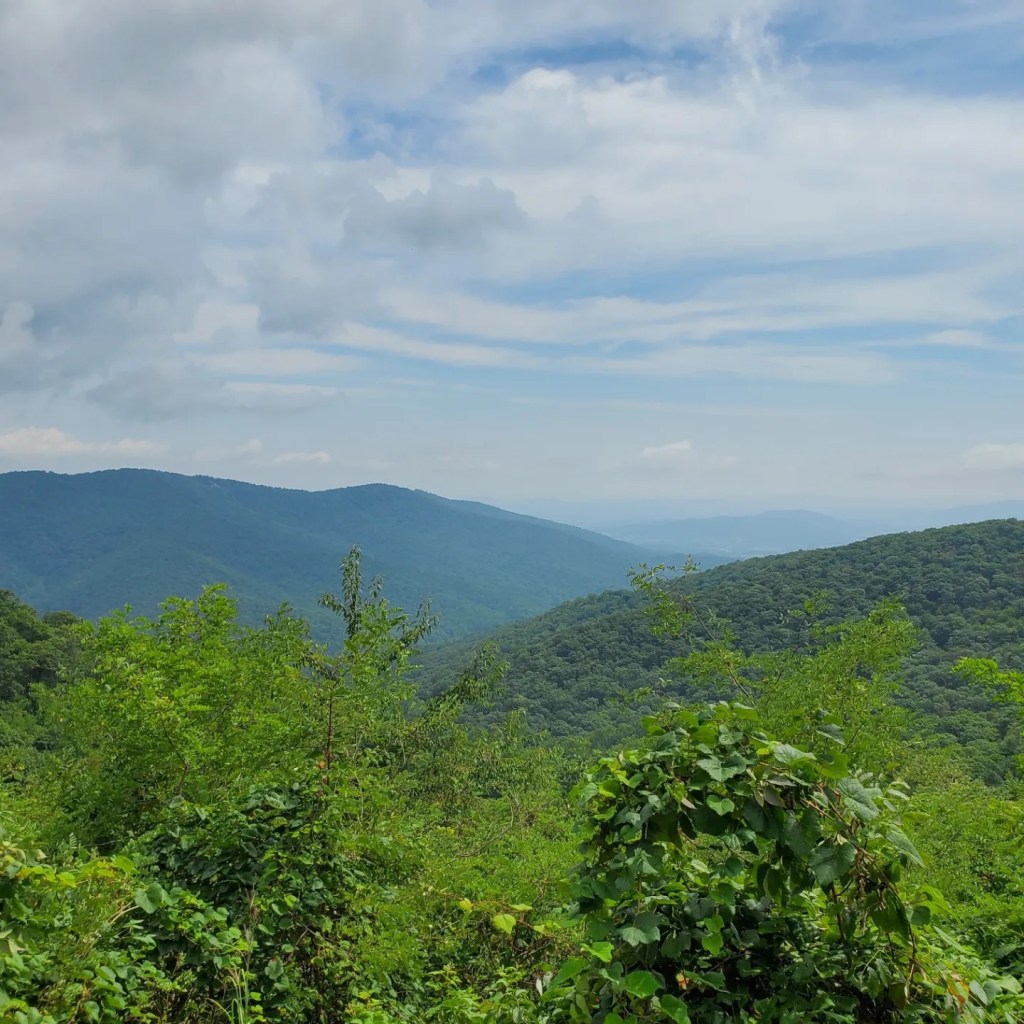
Here’s a photograph that I made in Thornton Gap, Virginia, near Mary’s Rock. It is at the border of Page and Rappahannock Counties. Thornton Gap (in the 1860s and 1870) is the setting for my Rattlesnake Granny Books.
The area where the books take place is now part of Shenandoah National Park. This vicinity would have looked rather different for Nancy Pullum and the other characters in the books than it does today.
For one thing, they likely saw fewer introduced species than we do. For example, is that kudzu in the foreground? It wasn’t introduced in America until 1876. The books are also set before the introduced fungal American chestnut blight killed the giant American chestnut trees that were so important to the mountaineers and a defining feature of the forests.
My stories are also set a decade or two before large-scale industrialized logging moved into the general region.
That doesn’t mean that people weren’t already exploiting the land and its resources. Tanning leather was a major industry in the Shenandoah Valley at that time. The Barbee family operated a tannery in Thornton Gap near the Hawsburg and Bower homes. The Barbees had an outside supplier for their hides. To acquire tannic acid, mountaineers (or industrialists or their laborers) would cut trees, especially chestnut oaks, and peel their bark in the spring. The bark was left in piles before being rendered into use for tanning later in the year. Union troops burnt the Barbees’ tannery during the Civil War along with other tanneries and rural industries (and barns, etc.) in the region. I imagine the Barbees’ tannery was making goods for the Confederacy.
Trees were also being cut en masse to fuel iron furnaces. Charcoal burns hotter than logs, making it better than raw timber for smelting iron ore. It took a tremendous amount of wood (as charred over time in open hearths into charcoal) to fuel the furnaces. An old iron furnace could use over an acre of timber a day. There was no furnace complex that I know of in Thornton Gap. (The story about a cold blast furnace that appears in my second book is based on the West Fork Furnace in Floyd, Virginia.) Nevertheless, the fact that an iron furnace could use hundreds of acres of wood a year in charcoal means that the demand was heavy for timber. And timber would be re-cut every few decades unless the furnace operator decided that he had stripped the woods enough to close down the furnace and move on.
And here’s another way that the mountaineers used trees: there was a sawmill in Thornton Gap, powered by the river. Residents likely logged the biggest nearby trees and floated them down the river. The sawmill was said to have operated slowly, so slowly that the blade’s tender could doze off at work (not recommended.) At the sawmill site, there later grew a gristmill, blacksmith shop, and cider press, all powered by the Thornton River with goods perhaps floated down the river and/or carried out in wagons. We know that the infrastructure was in place to serve covered wagon traffic through the area at that time and an overnight stop for wagoners was near the mill.
The Barbee family also had a pottery at the Hawsburg complex at one time. Did they make use of a regional clay bank? (They had a lot going on at the Hawsburg, by the way. As well as a home for the big Barbee family, it was also a hotel for the stagecoach and post office.)
Paths and roads came early through Thornton Gap due to it being a natural pass through the mountains. We know that the Barbee family and their allied McKay family were continuing to develop roads in the area with the labor of free and enslaved African Americans.
Then there was homesteading and along with it, livestock. Mountaineers by custom let their livestock (especially pigs) forage freely through the woods. When the weather was warm, it was again the custom to move cattle to the mountainsides and mountaintops to graze. Farmers and other landowners would put out salt for the cattle. As there is with cattle, there would be grazed vegetation and compacted soil.
The area where the books are set is now maintained for conservation and recreational purposes. Debate remains over what state the land was in before Shenandoah National Park was built. Who was it that was causing wear to the land? Was it the mountaineer settlers with their livestock and rural industry? Was it the absentee landowners who were so prevalent before the Park was established and who lacked a vested interest in the quality of the area? Or was it outside industrialists with their mining and logging who eroded the soil and timber leading to fires and floods? Was the state of the land really that bad by the early 1900s? Or was the idea of mountaineers’ abuse of the land another form of propaganda to turn residents out of their homesteads and build support for the incoming Park?
 Rattlesnake Granny Books
Leave a comment