My Rattlesnake Granny Books are set in a small part of Thornton Gap, Virginia, after the American Civil War. The area where the book takes place is at the border of Page and Rappahannock Counties. The towns of Luray and Sperryville are nearby.
The narrator and protagonist is a mountaineer woman who I read about the in the papers of historian Dr. John W. Wayland. Dr. Wayland learned about her from talking with a marble sculptor named Herbert Barbee who grew up in Thornton Gap before and during the American Civil War.
Her name was Nancy Pullum. She caught rattlesnakes and made them into a medicinal oil that she sold to her neighbors. Herbert Barbee told Dr. Wayland that Nancy was fierce looking, smoked a pipe, was rough and tough, and had a heart of gold. I like to imagine her like this:
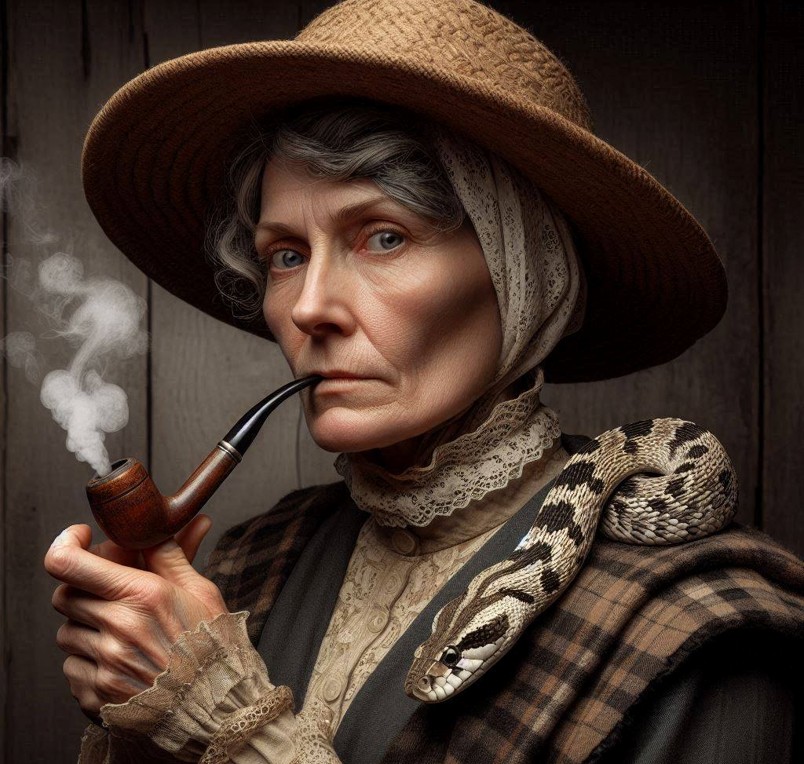
The Rattlesnake Granny books tell how Nancy caught her rattlers and how she survived life in her little cabin high on the mountainside. The books also explore Nancy’s interactions with her closest Thornton Gap neighbors. These include Herbert Barbee’s father William Randolph Barbee, his mother Mary Jane McKay Barbee, and a man who was freed from enslavement to the Barbee family. He is called “Uncle Bob” in the primary source and John in the book. These are my fictionalizations of historic people. Regional places also feature in the books. The stories are backed by primary and secondary sources and collections of regional folklore. Both books have bibliographies and notes on the story.
It was great fun to research the world in which these people lived and weave it into the Rattlesnake Granny tales. Mountaineer life ways feature in the first book. Rural industry is explored in the second book.
I am often asked about the dialect in which the fictional Nancy narrates her stories. It is shaped by the way my family spoke in rural Southwestern Virginia. It is also a product of a lifelong interest in mountaineer dialect.
It was important to me to portray all the characters as bright and skilled people, capable of navigating their environments. It is a push back of a sort against the idea that mountaineers were/are solitary and uneducated.
I also enjoyed learning about and alluding to the racial and ethnic diversity in the historic Blue Ridge and Shenandoah Valley. I believe that Native mountaineers and mountaineers of color were often underacknowledged in the earlier histories of this area.
Want to learn more? I love talking with groups and book clubs. Presentations are free in the Shenandoah Valley area with a book signing. My first presentation was The Rattlesnake Granny Road Show, a show and tell presentation using material culture to tell the story of the first book. I also offer a PowerPoint presentation on the true stories and history behind the second book. I’m working on a Powerpoint lecture on land use in 1800s Thornton Gap, Virginia. Email at: junktime2000@yahoo.com
 Rattlesnake Granny Books
Leave a comment